Equinox: Almost Equal Day and Night
Equinox in Latin means equal night, giving the impression that the night and day on the equinox are exactly 12 hours long. And even though this is common wisdom, it isn't entirely accurate.
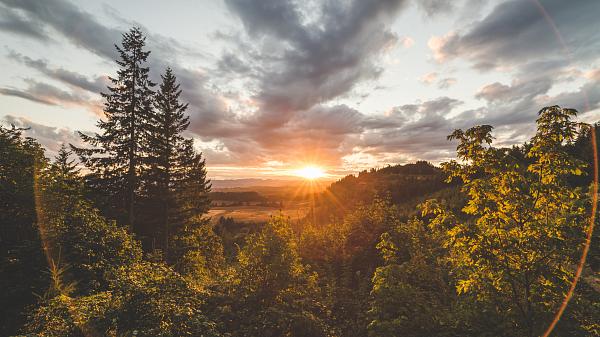
The day is just a bit longer than the night on an equinox.
©iStockphoto.com/shanecotee
The day and night are only nearly equal on the September equinox and the March equinox. In fact, most locations on Earth tend to enjoy more daylight hours than nighttime hours on these two days of the year, thanks to the Earth's atmosphere and our definition of sunrise and sunset.
Equilux: when day and night are (actually) equal
How long is the day where you are?
More Than 12 Hours of Sun
The next equinox is at 12:43 UTC on September 22, 2024. On this day, New York City residents will enjoy a 12 hour and 8 minutes long day. Those in Amsterdam will get 2 more minutes of daylight with a 12 hours and 10 minutes long day. Even in Longyearbyen, one of the world's northernmost cities, the day will last for 12 hours and 33 minutes.
Moving southwards, Melbourne in Australia will see a 12 hours and 7 minutes long day. Johannesburg inhabitants will also enjoy a similar number of daylight hours.
On the South Pole, the Sun will be up 24 hours. Perfect opportunity to see the Midnight Sun!
On the equator, the day is always a little longer than 12 hours all year round.
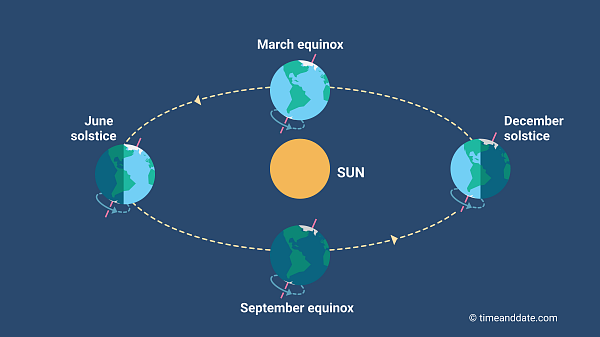
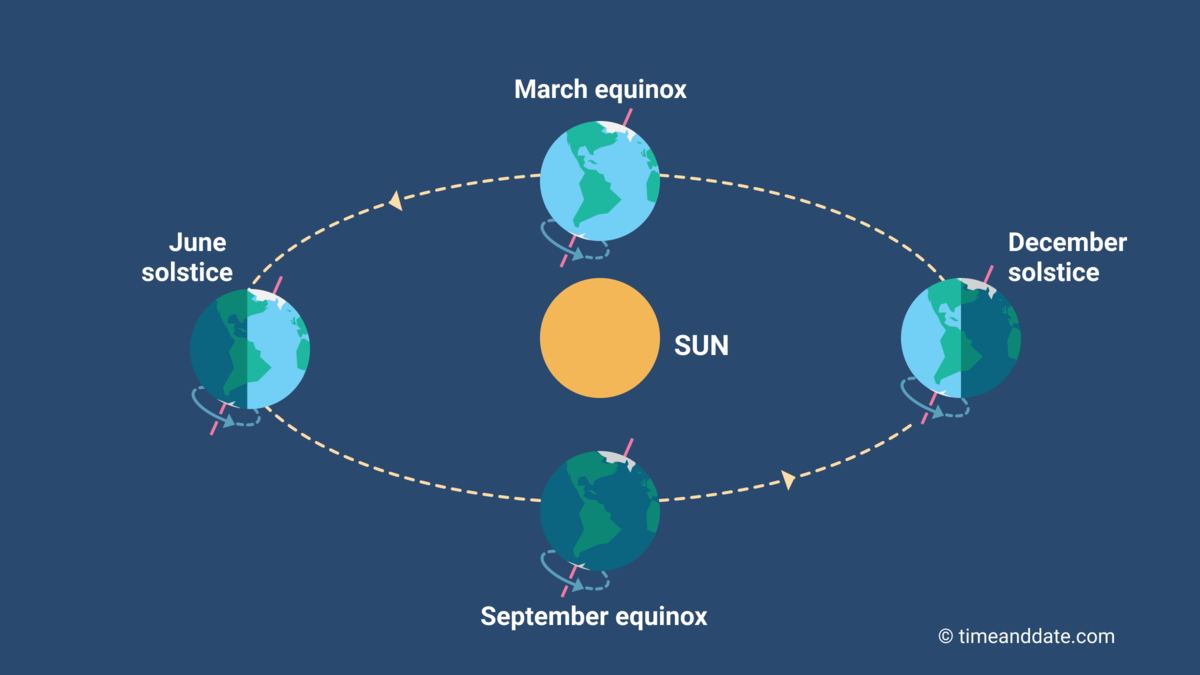
On the equinox, the tilt of Earth’s axis is perpendicular to the Sun’s rays as in the illustration.
©timeanddate.com
Sun's Upper Edge Defines Sunrise
One of the reasons why most locations on Earth do not enjoy exactly 12 hours of daytime and 12 hours of nighttime on the equinoxes is how sunrise and sunset are defined.
If sunrise and sunset were defined as the moment the geometric center of the Sun passes the horizon, then the day and night would be exactly 12 hours long. But that is not the case. Sunrise and Sunset are defined as the exact moment the upper edge of the Sun’s disk touches the eastern and the western horizon, respectively. The time it takes for the Sun to fully set, which can be several minutes, makes the day just a bit longer than the night on the equinoxes.
Approx. date of "Equal Day & Night"
| Latitude | March | September |
|---|---|---|
| 60° North | Mar 18 | Sep 25 |
| 55° North | Mar 17 | Sep 25 |
| 50° North | Mar 17 | Sep 25 |
| 45° North | Mar 17 | Sep 25 |
| 40° North | Mar 17 | Sep 26 |
| 35° North | Mar 16 | Sep 26 |
| 30° North | Mar 16 | Sep 27 |
| 25° North | Mar 15 | Sep 27 |
| 20° North | Mar 14 | Sep 28 |
| 15° North | Mar 12 | Sep 30 |
| 10° North | Mar 8 | Oct 4 |
| 5° North | Feb 24 | Oct 17 |
| Equator | No equal day and night | |
| 5° South | Apr 14 | Aug 29 |
| 10° South | Apr 1 | Sep 10 |
| 15° South | Mar 28 | Sep 14 |
| 20° South | Mar 26 | Sep 16 |
| 25° South | Mar 25 | Sep 17 |
| 30° South | Mar 24 | Sep 18 |
| 35° South | Mar 24 | Sep 19 |
| 40° South | Mar 23 | Sep 19 |
| 45° South | Mar 23 | Sep 19 |
| 50° South | Mar 23 | Sep 20 |
| 55° South | Mar 23 | Sep 20 |
| 60° South | Mar 22 | Sep 20 |
Refraction: Light Lingers
Another reason for why the day is longer than 12 hours on an equinox is because the Earth's atmosphere refracts sunlight.
This refraction, or bending of the light, causes the Sun’s upper edge to be visible from Earth several minutes before the edge actually reaches the horizon. The same thing happens at sunset when you can see the Sun for several minutes after it has dipped under the horizon. This causes every day on Earth, including the days of the equinoxes, to be at least 6 minutes longer than it would have been without this refraction.
The extent of refraction depends on atmospheric pressure and temperature. Our calculations in the Sunrise and Sunset Calculator assume the standard atmospheric pressure of 101.325 kPa and temperature of 15° C or 59° F.
Latitude Determines Day Length
Even if day and night aren’t exactly equal on the day of the equinox, there are days when sunlight hours and nighttime hours are both very close to 12 hours. This day is known as the equilux, and its date depends on a location’s latitude and can occur several days to weeks before or after an equinox.
The table shows approximate dates for when day and night are of similar lengths for some latitudes.