Do Sunglasses Protect Eyes in a Solar Eclipse?
Never look directly at the Sun. You can seriously hurt your eyes, and even go blind. Proper eye protection, like eclipse glasses or a special solar filter, is the only safe option. Sunglasses don't work.

Next Annular Solar Eclipse: Wed, Oct 2, 2024 … See animation
Next Eclipse: Partial Lunar Eclipse – Wed, Sep 18, 2024 … See animation
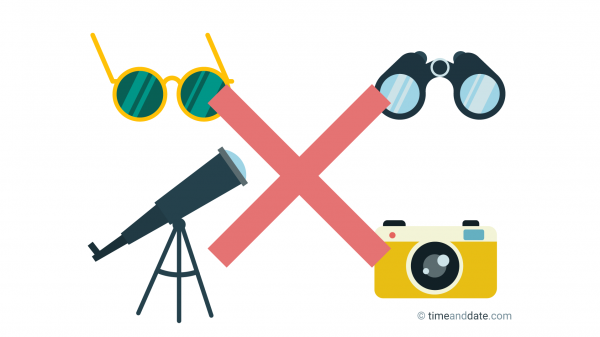
Protect your eyes seeing a solar eclipse.
How Not to Watch Solar Eclipses
According to NASA, the following materials should never be used to view a solar eclipse:
- sunglasses of any kind
- color film
- medical X-ray film
- smoked glass
- floppy disks
The Sun can burn the retinas in the eyes leading to permanent damage or even blindness. This can occur even if your eyes are exposed to direct sunlight for just a few seconds.
Safely Watch a Solar Eclipse
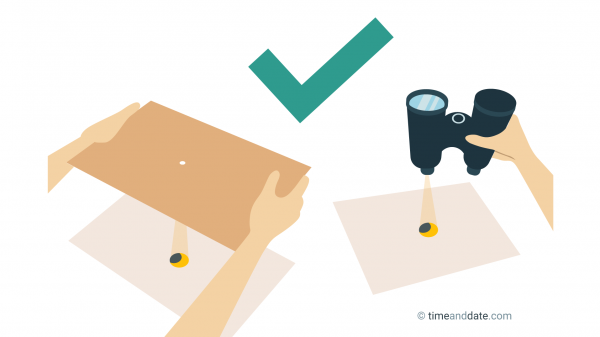
DIY: Project the Sun.
The only way to safely view the Sun – eclipsed or not – is to either project or filter the Sun's rays.
Projectors
Projection works well. You can make your own box projector or use a telescope or binoculars. However, don't look through the telescope’s eyepiece or side-mounted finder scope while projecting the Sun's image onto a screen.
Eclipse Glasses
The American Astronomical Society has compiled a list of vendors where you can buy safe eclipse glasses. Make sure you carefully read the instructions that come with the glasses.
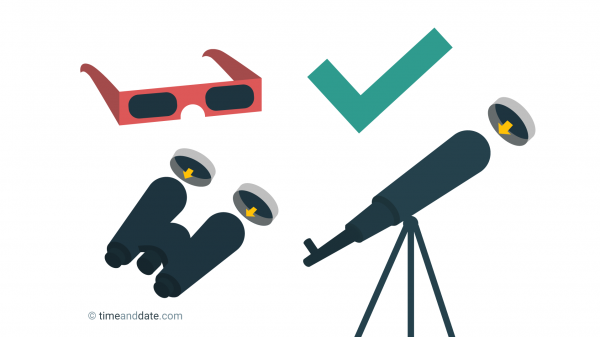
Use proper eclipse glasses and solar filters to protect your eyes.
NASA also recommends welder's glasses rated 14 or higher. These can be found at your local welding supply store. Keep in mind that welder glass grading may be different in different countries.
When to Use Eclipse Glasses
Eclipse glasses must be used whenever the disk of the Sun itself can be seen. This means:
- All the time during a partial eclipse
- All the time during an annular eclipse—this includes the brief moments of annularity, when the Sun forms a dazzling ‘ring of fire’ around the Moon
- During the partial phases of a total eclipse
In the brief moments of totality during a total solar eclipse, the Sun is completely covered, and the ghostly solar corona becomes visible around the Moon.
For these few moments, eclipse viewers can be safely removed. (In fact, if you don’t take off your eye protection, you won’t be able to see the solar corona.)
Four rules for using eclipse glasses
Solar Filters
You can use special solar filters to watch the Sun during a solar eclipse, but use the proper type of solar filter that is designed for eclipses. Check that filters do not crack under the Sun’s magnified and focused intensity. Solar filters must be treated with care, or they can quickly become damaged and unsafe to use.
How to take pictures of a solar eclipse
Solar filters should never be used with optical devices such as telescopes and binoculars, unless it is a specialist solar filter designed for use with that particular device. If you are uncertain about whether a filter is safe, do not use it. Avoid all risks.