What Is a Leap Second?
Every now and then, we add a leap second to our clocks to synchronize them with the Earth's rotation.
UPDATE: The End of Leap Seconds?
In November 2022, the General Conference on Weights and Measures (CGPM)—an international body that decides on global standards for how things are measured—passed a resolution asking the International Telecommunication Union (ITU) to consider changing the way we define civil time. Read the full story.

In Columbus, the previous leap second occurred on Saturday, December 31, 2016 at 6:59:60 pm.
UTC time was December 31, 2016 at 23:59:60.

Atomic clocks don't take into account the Earth's rotation.
©iStockphoto.com/kvkirillov
Next Leap Second
Latest update: In January 2025, the International Earth Rotation and Reference Systems Service (IERS) announced that “NO leap second will be introduced at the end of June 2025.”
The next possible date is December 31, 2025. However, the Earth's rotation has been relatively fast lately, so it is unlikely that any leap seconds will be added in the near future. In any case, we will publish the date of the next leap second here as soon as it has been officially announced.
Earth sets new record for shortest day
Why Do We Need Leap Seconds?
We add leap seconds from time to time to ensure our clocks reflect the Earth's rotation as accurately as possible. The speed at which our planet rotates around its axis fluctuates daily, and it slows down very slightly over time.
By adding an extra second to the time count, we effectively stop our clocks for that second to give Earth the opportunity to catch up.
Adding a leap second creates a minute with 61 seconds—and a day with 86,401 seconds instead of the usual 86,400.
About One Second Every 1.5 Years
An average Earth day is about 0.002 seconds longer than 24 hours. The difference grows to one second in about 1.5 years. However, the Earth's rotation speed fluctuates constantly, so the actual frequency of leap seconds can vary.
Planet Earth is an exceptionally accurate timekeeper
Added on June 30 or December 31
Leap seconds are traditionally added either on June 30 or on December 31. They occur at the end of the day, just before the clock ticks over to midnight.
On a digital clock, a leap second reads 23:59:60 or 11:59:60 pm.
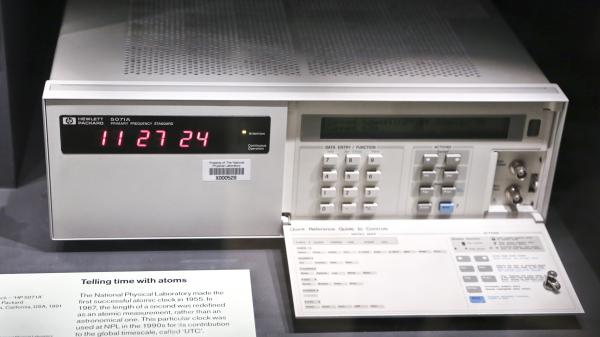
An atomic clock in Greenwich, U.K.
©itimeanddate.com/Steffen Thorsen
The Science Behind Leap Seconds
Coordinated Universal Time (UTC) is the world's time standard, and each time zone is defined by being a certain number of hours or minutes ahead or behind UTC.
At its core, UTC follows International Atomic Time (TAI). This time scale combines the output of some 200 highly precise atomic clocks maintained in laboratories around the world.
Atomic Clocks Are Too Accurate
The extraordinary accuracy of atomic time has one decisive disadvantage: it does not accurately reflect the length of a day on Earth. Due to the slowing of Earth's rotation, most days are very slightly longer than 24 hours.
Meanwhile, atomic clocks tick away at pretty much the same speed over millions of years. Compared to the Earth's rotation, atomic clocks are simply too consistent.
Earth's Lag Is Kept Below 0.9 Seconds
The average speed of Earth's rotation is measured by Universal Time (UT1). When the difference between UTC and UT1 is predicted to reach 0.9 seconds within 12 months, a leap second is added to UTC and clocks worldwide. In other words, our clocks are always kept within a second of the average length of a day.
In practice, the discrepancy is usually considerably smaller than 0.9 seconds when the leap second occurs. It is generally kept between 0.4 and 0.6 seconds.
The International Earth Rotation and Reference Systems Service (IERS) in Paris, France, is responsible for monitoring the Earth's rotation and deciding when a leap second is to be inserted.

Star tracks caused by the Earth's rotation, made visible in this long-exposure shot.
©iStockphoto.com/river34
How Far Are UTC, UT1, and TAI Apart?
Because whole seconds are added, the time difference between TAI and UTC amounts to an integral number of seconds, while the time difference between UTC and UT1 is always less than 0.9 seconds.
27 Seconds Added So Far
UTC was already 10 seconds behind TAI before the first leap second was added in 1972. Since then, a total of 27 leap seconds have been added (see table).
This means that UTC is currently 37 seconds behind TAI (see UTC and TAI clocks).
Negative Leap Seconds
Leap seconds can be positive (1 second added to the schedule) or negative (1 second omitted). So far, all leap seconds have been positive. However, if the Earth's rotation keeps accelerating, as it has done in 2020, the IERS may decide to announce the world's first negative leap second at some point in the future.
Speaking of time “leaps:” Is time travel possible?
Days Grow Longer
Not only do days become longer, but the rate at which day lengths increase also grows over time—but only by about two-thousandths of a second per century, according to Dr. Bruce Warrington, from Australia’s National Measurement Institute (NMI).
At the moment, days are 0.002 seconds longer than the sum of 86,400 seconds measured by atomic clocks; in 100 years, each day is predicted to be 0.004 seconds longer on average.