What Are Eclipses and Transits?
Eclipses and transits are astronomical events where a celestial body partially or totally covers another celestial object.

Next Partial Lunar Eclipse: Wed, Sep 18, 2024 … See animation
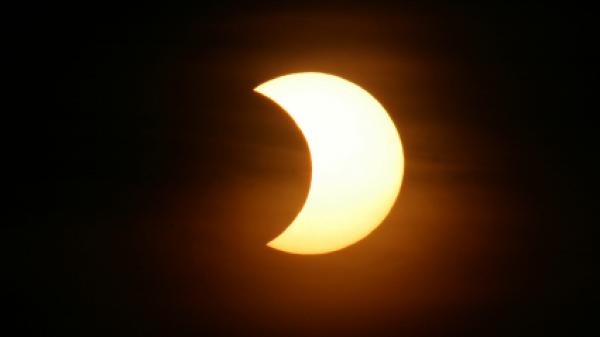
A partial solar eclipse.
©iStockphoto.com/Hans-Walter Untch
Types of Eclipses
From Earth, we can see two types of eclipses—eclipses of the Sun (solar eclipses) and eclipses of the Moon (lunar eclipses). These occur when the Sun, Earth, and the Moon align in a straight or almost straight configuration. Astronomers call this a syzygy, from the ancient Greek word syzygia, meaning to be yoked together or conjoined.
Which cities get the most eclipses?
The term eclipse also finds its roots in ancient Greek—it comes from the word ékleipsis, meaning to fail or to abandon.
Eclipses, solar and lunar, have fascinated scientists and laypeople for centuries. In ancient times, eclipses were seen as phenomena to be feared – many cultures came up with stories and myths to explain the temporary darkening of the Sun or the Moon. In recent centuries, scientists and astronomers follow eclipses in order to study and examine our natural world.
Eclipses and Transits 1900-2199
Solar Eclipses
Solar eclipses can only occur during a New Moon when the Moon moves between Earth and the Sun, and the three celestial bodies form a straight line: Earth–Moon–Sun.
There are between two and five solar eclipses every year.
There are three kinds of solar eclipses: total, partial, and annular. There is also a rare hybrid that is a combination of an annular and a total eclipse.
Total Solar Eclipses
A total solar eclipse occurs when the Moon completely covers the Sun, as seen from Earth. Totality during such an eclipse can only be seen from a limited area, shaped like a narrow belt, usually about 160 km (100 mi) wide and 16,000 km (10,000 mi) long. Areas outside this track may be able to see a partial eclipse of the Sun.
Looking at a solar eclipse without any protective eyewear can severely harm your eyes. The only way to safely watch a solar eclipse is to wear protective eclipse glasses or project an image of the eclipsed Sun using a DIY Pinhole Projector.
Total Solar Eclipses 1900-2199
Partial Solar Eclipses
A partial solar eclipse happens when the Moon only partially covers the disk of the Sun.
All Partial Solar Eclipses 1900-2199
Annular Solar Eclipses
An annular solar eclipse occurs when the New Moon covers the Sun's center, leaving its outer edges to form a “ring of fire” or annulus.
All Annular Solar Eclipses 1900-2199
Hybrid Solar Eclipses
A hybrid solar eclipse is a rare form of a solar eclipse, which changes from an annular to a total solar eclipse, and vice versa, along its path.
Lunar Eclipses
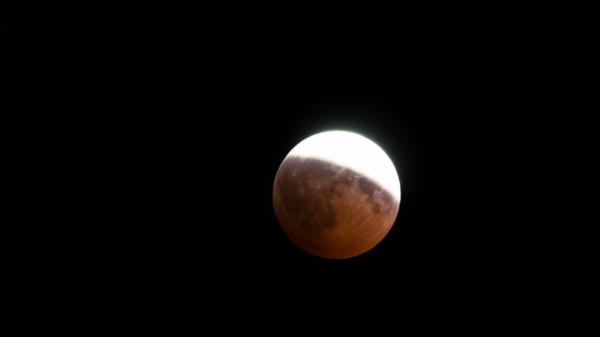
Partial lunar eclipse in 2008 as seen from Germany.
©iStockphoto.com/cinoby
The Moon does not have its own light. It shines because its surface reflects the Sun's rays. A lunar eclipse occurs when Earth comes between the Sun and the Moon and blocks the Sun's rays from directly reaching the Moon. Lunar eclipses only happen at Full Moon.
There are three kinds of lunar eclipses: total, partial, and penumbral.
Total Lunar Eclipses
A total lunar eclipse occurs when Earth's umbra,the central, dark part of its shadow,covers all of the Moon's surface.
All Total Lunar Eclipses 1900-2199
Partial Lunar Eclipses
When only part of the Moon's surface is obscured by Earth’s umbra, we see a partial lunar eclipse.
All Partial Lunar Eclipses 1900-2199
Penumbral Lunar Eclipses
A penumbral lunar eclipse happens when the Moon travels through the faint penumbral portion of Earth’s shadow.
All Penumbral Lunar Eclipses 1900-2199
Planet Transits
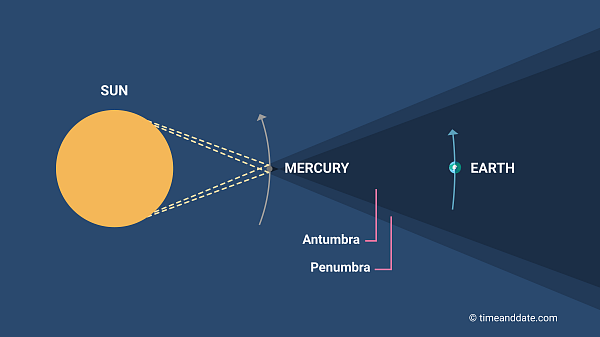
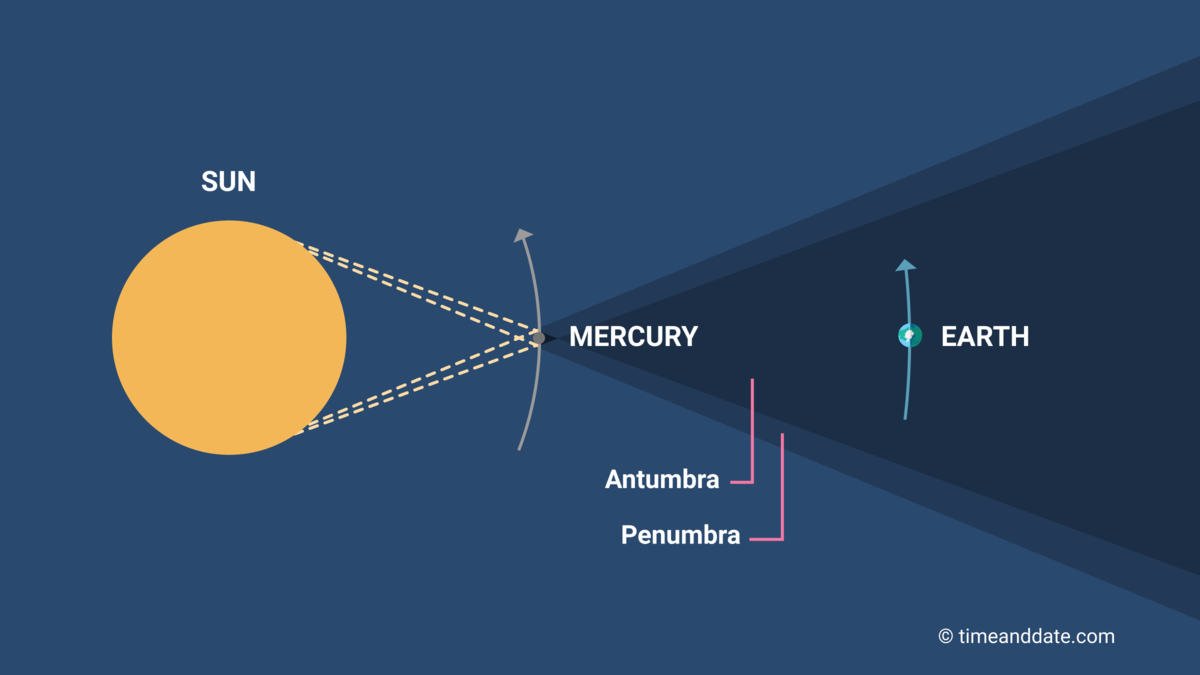
A transit of Mercury. (Illustration not to scale.)
When a planet comes between Earth and the Sun, it is called a transit. Mercury and Venus are the only two planets that can be seen transiting the Sun from Earth. This is because they are the only planets in the solar system whose orbit is inside Earth's orbit.
From 2000–2199, there will be 14 transits of Mercury. Venus transits are rare, with only 2 this century, in 2004 and 2012.