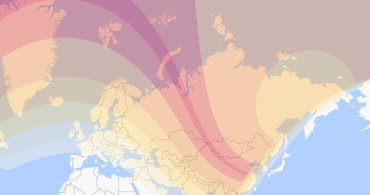
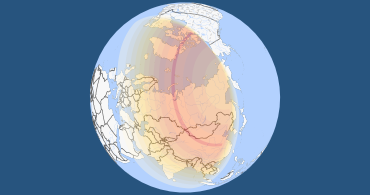
The total solar eclipse on August 1, 2008 begins in Canada and extends across northern Greenland, the Arctic region, central Russia, Mongolia, and China. A partial eclipse is seen within the broader path of the moon's penumbra (partially shaded outer region), which includes northeastern North America, most of Europe, the Middle East and western parts of Asia.
This eclipse wasn't visible in Wichita - Which upcoming eclipses can be seen in your location?
Where the Eclipse Was Seen
Try our new interactive eclipse maps. Zoom in and search for accurate eclipse times and visualizations for any location.
Path of the Eclipse Shadow
Regions that saw, at least, a partial eclipse: Europe, Asia, Much of North America, Atlantic, Indian Ocean, Arctic.
The eclipse's path
The path of this eclipse begins in the Northwest Territories in Canada and finishes in north-central China. Though the central shadow narrowly misses Cambridge Bay on Victoria Island and Resolute on Cornwallis Island, its edge just nips the town of Alert on Ellesmere Island, giving residents 40 seconds of early morning totality.
Across the Atlantic north, the eclipse’s path skips across Greenland’s northernmost coast and comes within about 720 kilometers (450 miles) of the North Pole before heading southward toward more moderate climes. Totality of the eclipse passes by Svalbard in Norway and touches Russia’s Franz Josef Land island group before cutting across Novaya Zemlya on its way to mainland Asia.
The umbra first touches the Russian coast of the Yamal Peninsula. The solar eclipse occurs closer to the inland, producing about two minutes and 27 seconds of totality and reaches near the town of Nadym, inland from the boot shaped Gulf of Obskaja. Continuing to hook towards the southeast, the central path passes near Novosibirsk where totality lasts about two minutes and 18 seconds. The path then enters western Mongolia, with the towns of Olgij and Bulgan seeing about two minutes of a total eclipse. A total eclipse then occurs in north-central China before the umbra leaves Earth just north of the cities of Lanzhou and Xian. A partial eclipse will be seen throughout northeastern North America, most of Europe, the Middle East and western parts of Asia.
This eclipse wasn't visible in Wichita - Which upcoming eclipses can be seen in your location?
Eclipse Shadow Path
0%
>0%
40%
90%
100%
The dark areas symbolize night and twilight.
When the Eclipse Happened Worldwide — Timeline
The eclipse started at one location and ended at another. The times below are actual times (in UTC) when the eclipse occurred. This calculation uses a Delta T value of 65.6 seconds.
| Eclipse Stages Worldwide | UTC Time | Local Time in Wichita* |
|---|---|---|
| First location to see the partial eclipse begin | Aug 1 at 08:04:07 | Aug 1 at 3:04:07 am |
| First location to see the full eclipse begin | Aug 1 at 09:21:07 | Aug 1 at 4:21:07 am |
| Maximum Eclipse | Aug 1 at 10:21:15 | Aug 1 at 5:21:15 am |
| Last location to see the full eclipse end | Aug 1 at 11:21:26 | Aug 1 at 6:21:26 am |
| Last location to see the partial eclipse end | Aug 1 at 12:38:25 | Aug 1 at 7:38:25 am |
* These local times do not refer to a specific location but indicate the beginning, peak, and end of the eclipse on a global scale, each line referring to a different location. This eclipse isn't visible in Wichita.
Upcoming eclipses visible in Wichita
Next Total Solar Eclipse will be on Jul 21 – Jul 22, 2009
Eclipse calculations usually accurate to a few seconds
Countries Where the Eclipse Is Visible
| Country | Type | Start of Eclipse | End of Eclipse |
|---|---|---|---|
| Canada | Total Solar Eclipse | 5:34 am NDT | 6:30 am EDT |
| China | Total Solar Eclipse | 5:54 pm CST | 8:27 pm CST |
| Greenland | Total Solar Eclipse | 6:07 am WGST | 8:35 am WGST |
| Kazakhstan | Total Solar Eclipse | 2:21 pm ORAT | 6:07 pm KGT |
| Mongolia | Total Solar Eclipse | 4:54 pm HOVT | 7:04 pm HOVT |
| Russia | Total Solar Eclipse | 12:43 pm MSD | 6:55 pm |
| Svalbard and Jan Mayen | Total Solar Eclipse | 10:38 am CEST | 12:48 pm CEST |
| Afghanistan | Partial Solar Eclipse | 2:36 pm AFT | 4:50 pm AFT |
| Albania | Partial Solar Eclipse | 11:26 am CEST | 12:27 pm CEST |
| Armenia | Partial Solar Eclipse | 2:42 pm AMST | 4:46 pm AMST |
| Austria | Partial Solar Eclipse | 10:53 am CEST | 12:34 pm CEST |
| Azerbaijan | Partial Solar Eclipse | 2:41 pm AZST | 4:51 pm AZST |
| Bahrain | Partial Solar Eclipse | 1:39 pm AST | 3:01 pm AST |
| Bangladesh | Partial Solar Eclipse | 4:39 pm BST | 6:33 pm BST |
| Belarus | Partial Solar Eclipse | 11:51 am EEST | 2:09 pm EEST |
| Belgium | Partial Solar Eclipse | 10:36 am CEST | 12:15 pm CEST |
| Bhutan | Partial Solar Eclipse | 4:36 pm BTT | 6:28 pm BTT |
| Bosnia and Herzegovina | Partial Solar Eclipse | 11:09 am CEST | 12:33 pm CEST |
| Bulgaria | Partial Solar Eclipse | 12:18 pm EEST | 2:00 pm EEST |
| Cambodia | Partial Solar Eclipse | 5:57 pm ICT | 6:38 pm ICT |
| Croatia | Partial Solar Eclipse | 11:04 am CEST | 12:34 pm CEST |
| Cyprus | Partial Solar Eclipse | 1:05 pm | 2:11 pm |
| Czechia | Partial Solar Eclipse | 10:47 am CEST | 12:41 pm CEST |
| Denmark | Partial Solar Eclipse | 10:33 am CEST | 12:39 pm CEST |
| Estonia | Partial Solar Eclipse | 11:43 am EEST | 1:59 pm EEST |
| Faroe Islands | Partial Solar Eclipse | 9:20 am WEST | 11:18 am WEST |
| Finland | Partial Solar Eclipse | 11:38 am EEST | 2:01 pm EEST |
| France | Partial Solar Eclipse | 10:35 am CEST | 12:14 pm CEST |
| Georgia | Partial Solar Eclipse | 1:32 pm GET | 3:44 pm GET |
| Germany | Partial Solar Eclipse | 10:35 am CEST | 12:36 pm CEST |
| Greece | Partial Solar Eclipse | 12:32 pm EEST | 1:50 pm EEST |
| Guernsey | Partial Solar Eclipse | 9:35 am BST | 10:55 am BST |
| Hong Kong | Partial Solar Eclipse | 6:43 pm HKT | 7:04 pm HKT |
| Hungary | Partial Solar Eclipse | 10:59 am CEST | 12:49 pm CEST |
| Iceland | Partial Solar Eclipse | 8:14 am GMT | 10:17 am GMT |
| India | Partial Solar Eclipse | 3:47 pm IST | 6:07 pm IST |
| Indonesia | Partial Solar Eclipse | 6:20 pm WIB | 6:57 pm WIB |
| Iran | Partial Solar Eclipse | 2:17 pm IRDT | 4:51 pm IRDT |
| Iraq | Partial Solar Eclipse | 12:55 pm AST | 2:55 pm AST |
| Ireland | Partial Solar Eclipse | 9:20 am IST | 11:04 am IST |
| Isle of Man | Partial Solar Eclipse | 9:24 am BST | 11:06 am BST |
| Israel | Partial Solar Eclipse | 1:19 pm IDT | 2:11 pm IDT |
| Italy | Partial Solar Eclipse | 10:57 am CEST | 12:20 pm CEST |
| Japan | Partial Solar Eclipse | 7:02 pm JST | 7:23 pm JST |
| Jersey | Partial Solar Eclipse | 9:36 am BST | 10:53 am BST |
| Jordan | Partial Solar Eclipse | 1:15 pm EEST | 2:26 pm EEST |
| Kosovo | Partial Solar Eclipse | 11:23 am CEST | 12:34 pm CEST |
| Kuwait | Partial Solar Eclipse | 1:24 pm AST | 2:55 pm AST |
| Kyrgyzstan | Partial Solar Eclipse | 3:58 pm KGT | 6:11 pm KGT |
| Laos | Partial Solar Eclipse | 5:46 pm ICT | 6:57 pm ICT |
| Latvia | Partial Solar Eclipse | 11:44 am EEST | 2:01 pm EEST |
| Lebanon | Partial Solar Eclipse | 1:09 pm EEST | 2:17 pm EEST |
| Liechtenstein | Partial Solar Eclipse | 10:55 am CEST | 12:11 pm CEST |
| Lithuania | Partial Solar Eclipse | 11:45 am EEST | 1:59 pm EEST |
| Luxembourg | Partial Solar Eclipse | 10:42 am CEST | 12:12 pm CEST |
| Macau | Partial Solar Eclipse | 6:43 pm CST | 7:05 pm CST |
| Malaysia | Partial Solar Eclipse | 7:15 pm MYT | 7:39 pm MYT |
| Maldives | Partial Solar Eclipse | 4:35 pm MVT | 5:29 pm MVT |
| Moldova | Partial Solar Eclipse | 12:06 pm EEST | 2:06 pm EEST |
| Monaco | Partial Solar Eclipse | 11:23 am CEST | 11:36 am CEST |
| Montenegro | Partial Solar Eclipse | 11:20 am CEST | 12:30 pm CEST |
| Myanmar | Partial Solar Eclipse | 5:06 pm MMT | 7:00 pm MMT |
| Nepal | Partial Solar Eclipse | 4:15 pm NPT | 6:14 pm NPT |
| Netherlands | Partial Solar Eclipse | 10:34 am CEST | 12:22 pm CEST |
| North Korea | Partial Solar Eclipse | 7:09 pm KST | 7:55 pm KST |
| North Macedonia | Partial Solar Eclipse | 11:28 am CEST | 12:36 pm CEST |
| Norway | Partial Solar Eclipse | 10:24 am CEST | 12:55 pm CEST |
| Oman | Partial Solar Eclipse | 2:36 pm GST | 4:19 pm GST |
| Pakistan | Partial Solar Eclipse | 4:12 pm | 6:29 pm |
| Palestine | Partial Solar Eclipse | 1:30 pm EEST | 2:04 pm EEST |
| Poland | Partial Solar Eclipse | 10:42 am CEST | 12:54 pm CEST |
| Qatar | Partial Solar Eclipse | 1:40 pm AST | 3:03 pm AST |
| Romania | Partial Solar Eclipse | 12:04 pm EEST | 2:04 pm EEST |
| Saint Pierre and Miquelon | Partial Solar Eclipse | 6:24 am PMDT | 7:24 am PMDT |
| San Marino | Partial Solar Eclipse | 11:16 am CEST | 12:03 pm CEST |
| Saudi Arabia | Partial Solar Eclipse | 1:21 pm AST | 3:12 pm AST |
| Serbia | Partial Solar Eclipse | 11:08 am CEST | 12:43 pm CEST |
| Slovakia | Partial Solar Eclipse | 10:56 am CEST | 12:49 pm CEST |
| Slovenia | Partial Solar Eclipse | 11:02 am CEST | 12:29 pm CEST |
| South Korea | Partial Solar Eclipse | 7:16 pm KST | 7:49 pm KST |
| Sri Lanka | Partial Solar Eclipse | 4:49 pm IST | 6:07 pm IST |
| Sweden | Partial Solar Eclipse | 10:32 am CEST | 12:52 pm CEST |
| Switzerland | Partial Solar Eclipse | 10:51 am CEST | 12:12 pm CEST |
| Syria | Partial Solar Eclipse | 12:55 pm EEST | 2:38 pm EEST |
| Taiwan | Partial Solar Eclipse | 6:36 pm CST | 6:49 pm CST |
| Tajikistan | Partial Solar Eclipse | 3:01 pm TJT | 5:14 pm TJT |
| Thailand | Partial Solar Eclipse | 5:50 pm ICT | 7:05 pm ICT |
| Turkey | Partial Solar Eclipse | 12:30 pm EEST | 2:43 pm EEST |
| Turkmenistan | Partial Solar Eclipse | 2:45 pm TMT | 5:11 pm TMT |
| Ukraine | Partial Solar Eclipse | 11:55 am EEST | 2:25 pm EEST |
| United Arab Emirates | Partial Solar Eclipse | 2:37 pm GST | 4:13 pm GST |
| United Kingdom | Partial Solar Eclipse | 9:16 am BST | 11:22 am BST |
| United States | Partial Solar Eclipse | 12:57 am AKDT | 2:13 am AKDT |
| Uzbekistan | Partial Solar Eclipse | 2:41 pm UZT | 5:12 pm UZT |
| Vietnam | Partial Solar Eclipse | 5:44 pm ICT | 6:52 pm ICT |
| Yemen | Partial Solar Eclipse | 2:17 pm AST | 2:56 pm AST |
| Åland Islands | Partial Solar Eclipse | 11:40 am EEST | 1:50 pm EEST |
All times shown in this table are local time. (Note: more than one time zone is listed.)
How Many People Can See This Eclipse?
| Number of People Seeing... | Number of People* | Fraction of World Population |
|---|---|---|
| Any part of the eclipse | 3,770,000,000 | 55.37% |
| At least 10% partial | 3,440,000,000 | 50.50% |
| At least 20% partial | 2,980,000,000 | 43.78% |
| At least 30% partial | 2,630,000,000 | 38.68% |
| At least 40% partial | 2,270,000,000 | 33.41% |
| At least 50% partial | 1,940,000,000 | 28.55% |
| At least 60% partial | 1,210,000,000 | 17.82% |
| At least 70% partial | 870,000,000 | 12.77% |
| At least 80% partial | 675,000,000 | 9.92% |
| At least 90% partial | 435,000,000 | 6.39% |
| Totality or annularity | 67,700,000 | 0.99% |
* The number of people refers to the resident population (as a round number) in areas where the eclipse is visible. timeanddate has calculated these numbers using raw population data provided by the Center for International Earth Science Information Network (CIESIN) at Columbia University. The raw data is based on population estimates from the year 2000 to 2020.

An Eclipse Never Comes Alone!
A solar eclipse always occurs about two weeks before or after a lunar eclipse.
Usually, there are two eclipses in a row, but other times, there are three during the same eclipse season.
This is the first eclipse this season.
Second eclipse this season: August 16, 2008 — Partial Lunar Eclipse
Eclipses in 2008
- Annular solar eclipse on February 7
- Total lunar eclipse on February 21
- Partial lunar eclipse on August 16