
Skywatching Tips for August
What’s up in the day and night sky in August 2025, including the Perseid meteor shower, a close approach between Venus and Jupiter, and a Black Moon.

Jewish communities recall the date Moses received the Ten Commandments and celebrate a time of harvest on Shavuot.

Also known as the Festival of Weeks, Shavuot is marked by food, prayers, and green decorations.
© iStockphoto.com/chameleonseye
While this is not a public holiday in the United States, some Jewish-run organizations are closed on this date.
Shavuot is celebrated on the 6th day of the month of Sivan in the Hebrew calendar, which usually falls in May in the Gregorian calendar.
Shavuot represents both the end of a holy period of seven weeks after Passover and the start of the covenant, or sacred pact, between God and the Jewish people.
The biblical story holds that while the Israelites were encamped at the foot of Mount Sinai, Moses climbed to the summit and received the Ten Commandments on the 50th day after their flight from slavery in Egypt. On that day, it is said the mountain bloomed into greenery.
Today, Shavuot is used to focus on spiritual cleansing meant to purify worshippers for a new year, and to celebrate the first harvest of crops.
In more religious communities, students may stay up all night to study the Torah on the eve of Shavuot. This tradition is thought to be an act of repentance for the Israelites, who were said to have overslept on the day that Moses came down from Mount Sinai with the commandments.
For many Jews, Shavuot is primarily a harvest celebration. In ancient times, a gold basket bearing the first “fruits” or harvest of crops was brought to the Temple in Jerusalem on this date. Among the offerings were barley, dates, figs, grapes, olives, pomegranates, and wheat. Today, symbolic baskets are often created for the holiday and may include other crops grown in Jewish communities.
Another modern tradition is eating dairy foods. The biblical reason for this is that Shavuot is connected to the nation´s exodus from Egypt into the Promised Land, where, according to the Book of Exodus, the Jews went "From the misery of Egypt to a country flowing with milk and honey…" (Exodus 3:8-17).
In the Ashkenazi, or European Jewish community, foods made with dairy products like cheesecake and blintzes are served to echo that scripture passage. Sephardic or North African Jewish communities prefer cheese kelsonnes (a kind of ravioli) and a seven–layer cake known as Siete Cielos (Seven Heavens) to celebrate the day.
Some other religious traditions have holidays that echo the timing of Shavuot. The Christian festival of Pentecost, for example, is observed seven weeks, or 49 days, after Easter Sunday, and celebrates a similar idea of the passing of divine wisdom or spirit to a group of followers.
In the Jewish diaspora—Jewish communities outside of Israel—an extra day is usually added to religious observances, with the exception of Yom Kippur, which lasts only one day worldwide, and Rosh Hashana, which is celebrated over two days in both Israel and the diaspora.
This custom has its roots in ancient times when the beginning of the months in the Jewish calendar still relied on the sighting of the crescent Moon following a New Moon.
The beginning of a new month was determined by the Sanhedrin, the supreme court of ancient Israel in Jerusalem. Once the date was published, messengers were dispatched to spread the news among Jews living abroad. Since this process took some time, it was decreed that Jews outside of ancient Israel were to observe every holiday for 2 days to make sure that the rules and customs applicable to each holiday were observed on the proper date. This rule is still observed today.
Note: Jewish holidays begin at sundown the day before the date specified for the holiday.
| Year | Weekday | Date | Name | Holiday Type |
|---|---|---|---|---|
| 2020 | Fri | May 29 | Shavuot | Jewish holiday |
| 2021 | Mon | May 17 | Shavuot | Jewish holiday |
| 2022 | Sun | Jun 5 | Shavuot | Jewish holiday |
| 2023 | Fri | May 26 | Shavuot | Jewish holiday |
| 2024 | Wed | Jun 12 | Shavuot | Jewish holiday |
| 2025 | Mon | Jun 2 | Shavuot | Jewish holiday |
| 2026 | Fri | May 22 | Shavuot | Jewish holiday |
| 2027 | Fri | Jun 11 | Shavuot | Jewish holiday |
| 2028 | Wed | May 31 | Shavuot | Jewish holiday |
| 2029 | Sun | May 20 | Shavuot | Jewish holiday |
| 2030 | Fri | Jun 7 | Shavuot | Jewish holiday |
While we diligently research and update our holiday dates, some of the information in the table above may be preliminary. If you find an error, please let us know.
What’s up in the day and night sky in August 2025, including the Perseid meteor shower, a close approach between Venus and Jupiter, and a Black Moon.
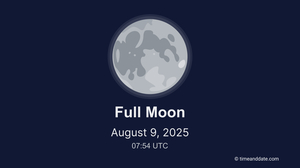
August’s Moon phases and close approaches. Plus, it’s a month with two First Quarter Moons—whichever time zone you’re in. Find out why this is a tight squeeze.
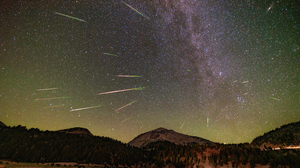
Discover when, where, and how to watch the 2025 Perseid Meteor Shower, including tips for catching the best views despite the bright Full Moon.

Purple Heart Day on August 7 commemorates the day in 1782 when General George Washington created the Purple Heart Medal – a military decoration that is awarded to those wounded or killed while serving in the United States Armed Forces.