The penumbral lunar eclipse on February 9, 2009 is the first lunar eclipse of the year. People can experience the eclipse in areas such as Alaska, Australia, eastern Asia, Hawaii, and New Zealand. This eclipse follows an annular solar eclipse that was 2009’s first eclipse.
This eclipse wasn't visible in Columbus - Which upcoming eclipses can be seen in your location?
Where the Eclipse Was Seen
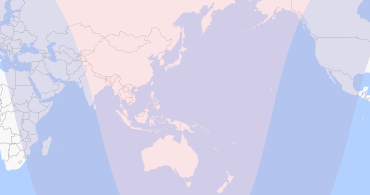
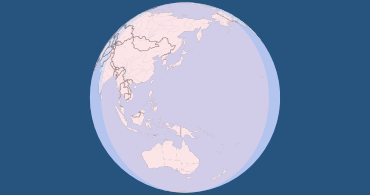
Try our new interactive eclipse maps. Zoom in and search for accurate eclipse times and visualizations for any location.
Regions seeing, at least, some parts of the eclipse: Much of Europe, Asia, Australia, Much of Africa, Much of North America, Pacific, Atlantic, Indian Ocean, Arctic, Antarctica.
This eclipse wasn't visible in Columbus - Which upcoming eclipses can be seen in your location?
Eclipse Map and Animation
The animation shows where this penumbral lunar eclipse is visible during the night (dark “wave” slowly moving across the Earth's surface).
Shades of darkness
Night, moon high up in sky.
Moon between 12 and 18 degrees above horizon.
Moon between 6 and 12 degrees above horizon. Make sure you have free line of sight.
Moon between 0 and 6 degrees above horizon. May be hard to see due to brightness and line of sight.
Day, moon and eclipse both not visible.
Note: Twilight will affect the visibility of the eclipse, as well as weather.
Note that since it is a penumbral eclipse, it can be hard to see, as the Moon will only be a bit fainter.
Eclipse was visible.
Eclipse was not visible at all.
Note: Areas with lighter shadings left (West) of the center will experience the eclipse after moonrise/sunset. Areas with lighter shadings right (East) of the center will experience the eclipse until moonset/sunrise. Actual eclipse visibility depends on weather conditions and line of sight to the Moon.
When the Eclipse Happened Worldwide — Timeline
Lunar eclipses can be visible from everywhere on the night side of the Earth, if the sky is clear. From some places the entire eclipse will be visible, while in other areas the Moon will rise or set during the eclipse.
| Eclipse Stages Worldwide | UTC Time | Local Time in Columbus* | Visible in Columbus |
|---|---|---|---|
| Penumbral Eclipse began | Feb 9 at 12:38:47 | Feb 9 at 7:38:47 am | No, below the horizon |
| Maximum Eclipse | Feb 9 at 14:38:12 | Feb 9 at 9:38:12 am | No, below the horizon |
| Penumbral Eclipse ended | Feb 9 at 16:37:38 | Feb 9 at 11:37:38 am | No, below the horizon |
* The Moon was below the horizon during this eclipse, so it was not possible to view it in Columbus.
Quick Facts About This Eclipse
| Data | Value | Comments |
|---|---|---|
| Magnitude | -0.089 | Fraction of the Moon’s diameter covered by Earth’s umbra |
| Obscuration | 0.0% | Percentage of the Moon's area covered by Earth's umbra |
| Penumbral magnitude | 0.900 | Fraction of the Moon's diameter covered by Earth's penumbra |
| Overall duration | 3 hours, 59 minutes | Period between the beginning and end of all eclipse phases |
Eclipse calculations usually accurate to a few seconds
How Many People Can See This Eclipse?
| Number of People Seeing... | Number of People* | Fraction of World Population |
|---|---|---|
| At least some of the penumbral phase | 4,800,000,000 | 69.70% |
| The entire eclipse from beginning to end | 2,970,000,000 | 43.05% |
* The number of people refers to the resident population (as a round number) in areas where the eclipse is visible. timeanddate has calculated these numbers using raw population data provided by the Center for International Earth Science Information Network (CIESIN) at Columbia University. The raw data is based on population estimates from the year 2000 to 2020.

An Eclipse Never Comes Alone!
A solar eclipse always occurs about two weeks before or after a lunar eclipse.
Usually, there are two eclipses in a row, but other times, there are three during the same eclipse season.
This is the second eclipse this season.
First eclipse this season: January 26, 2009 — Annular Solar Eclipse