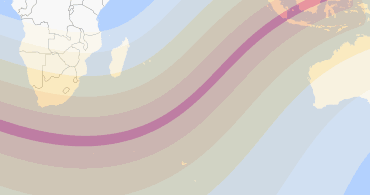
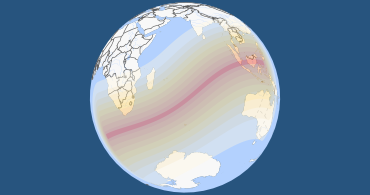
The year 2009 features a range of eclipses, starting with an annular solar eclipse on January 26. This particular eclipse is visible from an area that covers the Indian Ocean and western Indonesia.
This eclipse wasn't visible in Columbus - Which upcoming eclipses can be seen in your location?
Where the Eclipse Was Seen
Try our new interactive eclipse maps. Zoom in and search for accurate eclipse times and visualizations for any location.
Path of the Eclipse Shadow
Regions that saw, at least, a partial eclipse: South/East Asia, Australia, South in Africa, Pacific, Atlantic, Indian Ocean, Antarctica.
The eclipse's path
The eclipse can be seen in the southern third of Africa, Madagascar, many parts of Australia (except Tasmania), south-east India, and south-east Asia and Indonesia.
According to Harrington (1997), the cities of Kotabumi and Telukbetung in Indonesia experience more than six minutes of annularity while Krakatoa (or Krakatau), which is closer to the shadow’s edge, experiences less than five minutes of annularity. The town of Sampit, in Indonesia’s central Kalimantan province, and Samarinda, the capital of the Indonesian province of East Kalimantan, witness a lopsided ring-of-fire sunset eclipse as they are located near the southern extreme of annularity.
This eclipse wasn't visible in Columbus - Which upcoming eclipses can be seen in your location?
Eclipse Shadow Path
0%
>0%
40%
90%
100%
The dark areas symbolize night and twilight.
When the Eclipse Happened Worldwide — Timeline
The eclipse started at one location and ended at another. The times below are actual times (in UTC) when the eclipse occurred. This calculation uses a Delta T value of 65.8 seconds.
| Eclipse Stages Worldwide | UTC Time | Local Time in Columbus* |
|---|---|---|
| First location to see the partial eclipse begin | Jan 26 at 04:56:36 | Jan 25 at 11:56:36 pm |
| First location to see the full eclipse begin | Jan 26 at 06:02:41 | Jan 26 at 1:02:41 am |
| Maximum Eclipse | Jan 26 at 07:58:37 | Jan 26 at 2:58:37 am |
| Last location to see the full eclipse end | Jan 26 at 09:54:40 | Jan 26 at 4:54:40 am |
| Last location to see the partial eclipse end | Jan 26 at 11:00:40 | Jan 26 at 6:00:40 am |
* These local times do not refer to a specific location but indicate the beginning, peak, and end of the eclipse on a global scale, each line referring to a different location. This eclipse isn't visible in Columbus.
Upcoming eclipses visible in Columbus
Next Annular Solar Eclipse will be on Jan 15, 2010
Eclipse calculations usually accurate to a few seconds
Countries Where the Eclipse Is Visible
| Country | Type | Start | End | Annularity Duration |
|---|---|---|---|---|
| Cocos (Keeling) Islands | 2:25 pm CCT | 5:12 pm CCT | 4m, 58s | |
| Indonesia | 3:16 pm WIB | 5:59 pm WIB | 16m, 45s | |
| Malaysia | 4:29 pm MYT | 7:00 pm MYT | 3m, 7s | |
| Angola | 6:05 am WAT | 9:13 am CAT | --- | |
| Antarctica | 6:59 pm NZDT | 2:24 pm MAWT | --- | |
| Australia | 4:56 pm AWDT | 7:26 pm AWDT | --- | |
| Bangladesh | 3:16 pm BST | 4:42 pm BST | --- | |
| Bhutan | 3:22 pm IST | 3:42 pm IST | --- | |
| Botswana | 7:00 am SAST | 9:41 am SAST | --- | |
| British Indian Ocean Territory | 1:30 pm IOT | 4:27 pm IOT | --- | |
| Brunei | 4:40 pm MYT | 6:33 pm MYT | --- | |
| Cambodia | 3:46 pm ICT | 6:00 pm ICT | --- | |
| China | 5:01 pm CST | 6:51 pm CST | --- | |
| Christmas Island | 3:11 pm CXT | 5:44 pm CXT | --- | |
| Comoros | 9:23 am EAT | 11:11 am EAT | --- | |
| Congo Democratic Republic | 7:38 am CAT | 9:07 am CAT | --- | |
| East Timor | 4:32 pm WITA | 6:12 pm WITA | --- | |
| Eswatini | 7:08 am SAST | 9:58 am SAST | --- | |
| French Southern Territories | 10:29 am TFT | 2:38 pm TFT | --- | |
| Hong Kong | 5:07 pm HKT | 6:09 pm HKT | --- | |
| India | 2:04 pm IST | 4:28 pm IST | --- | |
| Japan | 6:06 pm JST | 6:28 pm JST | --- | |
| Laos | 3:53 pm ICT | 5:56 pm ICT | --- | |
| Lesotho | 7:03 am SAST | 9:54 am SAST | --- | |
| Macau | 5:07 pm CST | 6:10 pm CST | --- | |
| Madagascar | 8:29 am EAT | 12:00 noon EAT | --- | |
| Malawi | 7:35 am CAT | 9:45 am CAT | --- | |
| Maldives | 1:00 pm MVT | 3:31 pm MVT | --- | |
| Mauritius | 11:09 am | 2:52 pm | --- | |
| Mayotte | 9:21 am EAT | 11:19 am EAT | --- | |
| Micronesia | 6:48 pm CHUT | 6:48 pm CHUT | --- | |
| Mozambique | 7:09 am SAST | 10:05 am CAT | --- | |
| Myanmar | 3:13 pm MMT | 5:29 pm MMT | --- | |
| Namibia | 6:57 am CAT | 9:32 am SAST | --- | |
| Palau | 5:44 pm | 6:26 pm | --- | |
| Papua New Guinea | 6:38 pm PGT | 6:03 pm WIT | --- | |
| Philippines | 4:43 pm | 6:17 pm | --- | |
| Reunion | 10:02 am RET | 1:26 pm RET | --- | |
| Saint Helena | 5:40 am GMT | 7:18 am GMT | --- | |
| Seychelles | 10:57 am SCT | 1:21 pm SCT | --- | |
| Singapore | 4:29 pm SGT | 6:57 pm SGT | --- | |
| South Africa | 6:57 am SAST | 10:18 am SAST | --- | |
| South Georgia/Sandwich Is. | 3:44 am GST | 5:23 am GST | --- | |
| Sri Lanka | 1:58 pm IST | 4:15 pm IST | --- | |
| Taiwan | 5:04 pm CST | 5:47 pm CST | --- | |
| Tanzania | 8:12 am CAT | 9:21 am CAT | --- | |
| Thailand | 3:36 pm ICT | 6:00 pm ICT | --- | |
| Vietnam | 3:43 pm ICT | 6:00 pm ICT | --- | |
| Zambia | 7:15 am CAT | 9:22 am CAT | --- | |
| Zimbabwe | 7:12 am CAT | 9:48 am CAT | --- |
All times shown in this table are local time. (Note: more than one time zone is listed.) "Annularity duration" gives the time between the start and finish of annularity within the entire country (not at one location).
How Many People Can See This Eclipse?
| Number of People Seeing... | Number of People* | Fraction of World Population |
|---|---|---|
| Any part of the eclipse | 2,000,000,000 | 29.05% |
| At least 10% partial | 933,000,000 | 13.53% |
| At least 20% partial | 677,000,000 | 9.83% |
| At least 30% partial | 480,000,000 | 6.96% |
| At least 40% partial | 403,000,000 | 5.85% |
| At least 50% partial | 338,000,000 | 4.90% |
| At least 60% partial | 258,000,000 | 3.75% |
| At least 70% partial | 202,000,000 | 2.94% |
| At least 80% partial | 92,100,000 | 1.34% |
| Totality or annularity | 15,800,000 | 0.23% |
* The number of people refers to the resident population (as a round number) in areas where the eclipse is visible. timeanddate has calculated these numbers using raw population data provided by the Center for International Earth Science Information Network (CIESIN) at Columbia University. The raw data is based on population estimates from the year 2000 to 2020.

An Eclipse Never Comes Alone!
A solar eclipse always occurs about two weeks before or after a lunar eclipse.
Usually, there are two eclipses in a row, but other times, there are three during the same eclipse season.
This is the first eclipse this season.
Second eclipse this season: February 9, 2009 — Penumbral Lunar Eclipse